LA BOARD OF SUPERVISORS and RONALD REAGAN'S LETTER copyright by D'Lynn Waldron.PhD TEXT IS BELOW THE ILLUSTRATIONS
D'Lynn's Waldron's doctoral dissertation was on the problems of traditional societies in economic transition. After completing her degree, she was hired for a Federally funded position attached to the Board of Supervisors of Los Angeles County, to design HEW''s Model Cities community improvement program and HUD's Operation Breakthrough low income housing program. Her system design for the Operation Breakthrough low income housing program was adopted for use nationally by HUD.


Unfortunately, D'Lynn soon discovered that the people running the local jurisdictions, including the Los Angeles County Board of Supervisors, would tell HUD they were going to abide by D'Lynn's ''leak-proof" system design that would put the right housing in the right place for the right people. But once the politicians had the money they wouldn't build the low income housing. One supervisor used HUD money to repair his own properties and another used HEW money to pay his political wardheelers.

At that time there was a protein defficency among the African-American children in poor neighbors. A charitable group called Meals for Millions could produce for a penny each, cookies that would give each child a full day's ration of protein and vitamins. When I brought this to Kenny Hahn, he was unwilling to use grant money for something that did not help him get votes. "We'll stamp your name and picture on the cookies." "That won't do me any good; the kids will eat the cookies before their parents can see them."

When D'Lynn walked around the poorest neighborhoods to ask the people what they needed most, the surprising and all but universal reply was "Truant Officers to keep our kids in school." But the politicians had more personally profitable uses for the money. If, in 1968, those parents had been heeded, the gang problem that now afflicts Los Angeles might never have happened.

The multifarious misappropriations of the HUD and HEW grant money were covered up with false progress reports signed by supervisors themselves when, in spite of great pressure, D'Lynn refused to sign them.

D'Lynn found it impossible to prevent the corruption in government which was stealing the money intended for the poor. Therefore when the UN's development agency ECAFE offered her the position of being in charge of the social aspects of their economic programs for all of Asia she turned it down and instead devoted herself to making an ethnographic record of traditional ways of life in unspoiled settings before they disappeared. (A decade later D'Lynn learned that her Operation Breakthrough low income housing system design was being used by a UN development agency headquartered in Rome and she hoped it was with more success than in America.)

D'Lynn did, pro bono (without charge), in the late 1960's, the research design that the US Federal Trade Commission used to investigate the exploitation of the Native Americans who lived on reservations, that was perpetrated by the trading post system set up by the Bureau of Indian Affairs. As D'Lynn expected, the exploitations were the same type that she found in the societies all over the world which she had studied and written about in her doctoral dissertation. The BIA tried to block the release of the report by the FTC, but the FTC released it anyway and with the result that the BIA was forced to make significant reforms.

In the 1970's, while living in Connemara, on the wild West Coast of Ireland, D'Lynn lobbied for the economically exploited fishermen. D'Lynn is still active as a private citizen in protecting the environment and the poor from economic exploitation.

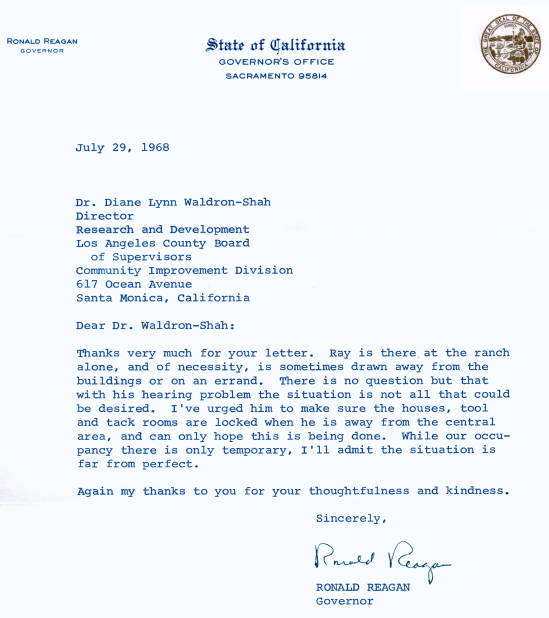
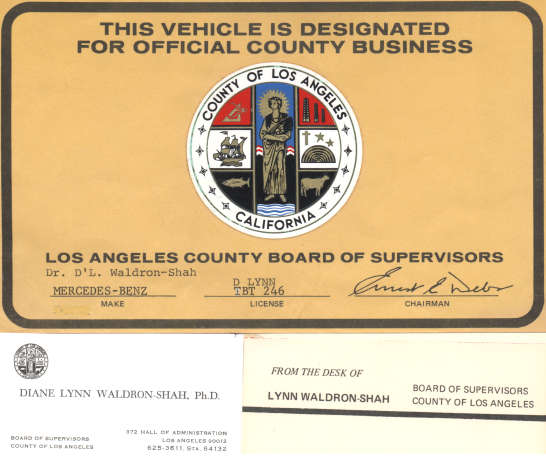
Above is a personal letter to D'Lynn from then Governor Ronald Reagan, and after that is D'Lynn's ID for the Board of Supervisors of Los Angeles County.

The personal letter from Ronald Reagan refers to a visit on his ranch in the Malibu hills during which D'Lynn learned there was no security what-so-ever after Governor Reagan left the ranch to return to Sacramento. It is interesting to note that Ronald Reagan put his personal friendship with his ranch foreman above the man's physical inability to maintain security.

Jumping forward four decades, D'Lynn has been asked to discuss ways to keep rent-paying tenants in their residences when landlords go into foreclosure.  Empty premises blight neighborhoods and destroy the surrounding property values. Instead of evicting rent-paying tenants, the property should be put in the hands of a competent management firm, which would benefit the city, the mortgage holders, and the tenants. However, securitized mortgages makes this complicated.