
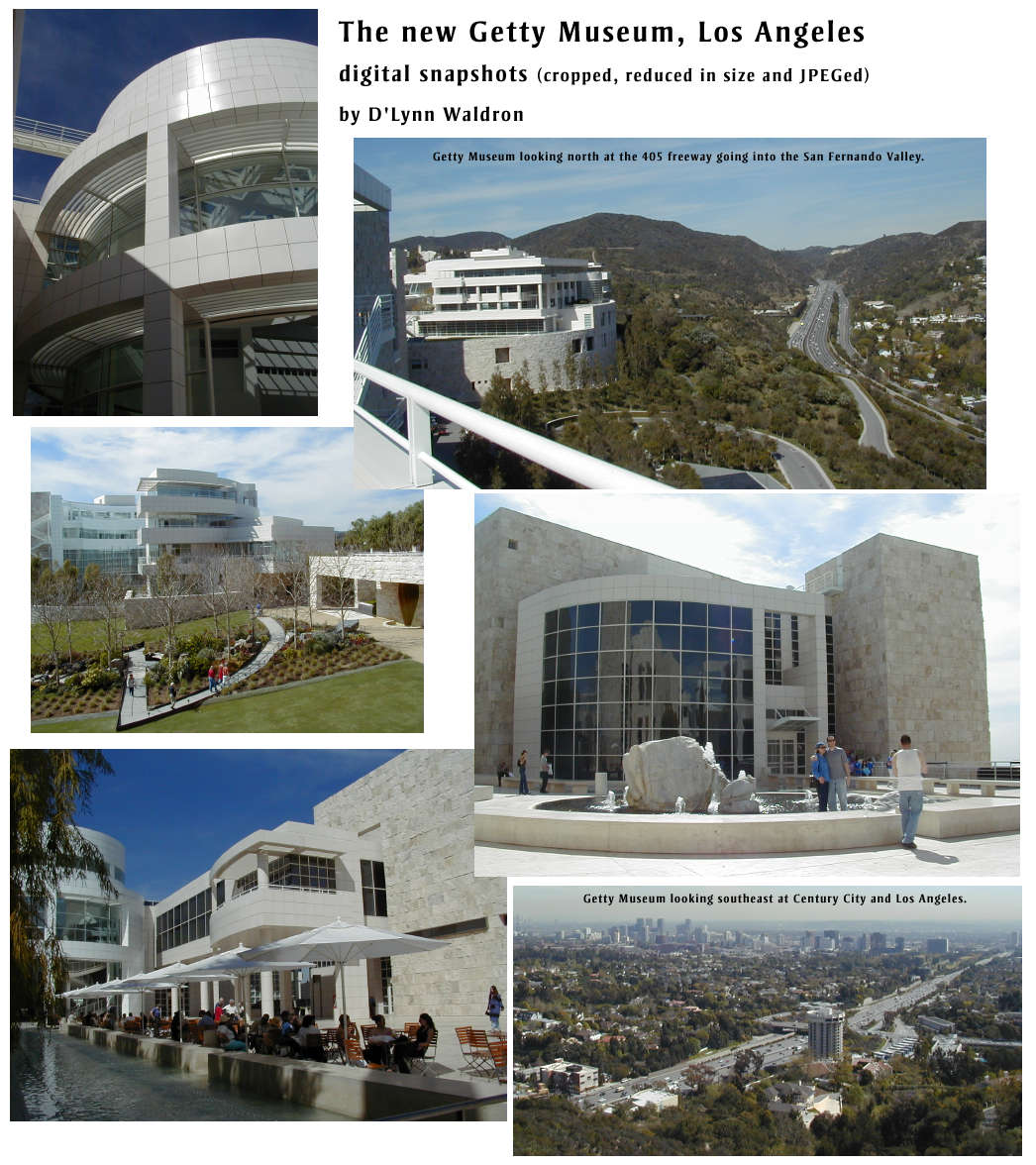
D'Lynn Waldron's Photographs and Commentary on the New Getty Museum, with her digital photographs copyright 2006
D'Lynn Waldron photographed the Getty Villa Museum in Malibu for J. Paul Getty (click for her article) and she was a guest when it was closed for major construction at the time the new Getty Museum was opened. When D'Lynn went to the new Getty Museum she found it the antithesis of the old museum in Malibu, and below the photographs are her comments. (Note: The photographs grouped into a composite have been reduced in size and highly compressed to save download time and that created artifacts and jaggies that are not in the original digital photographs.)
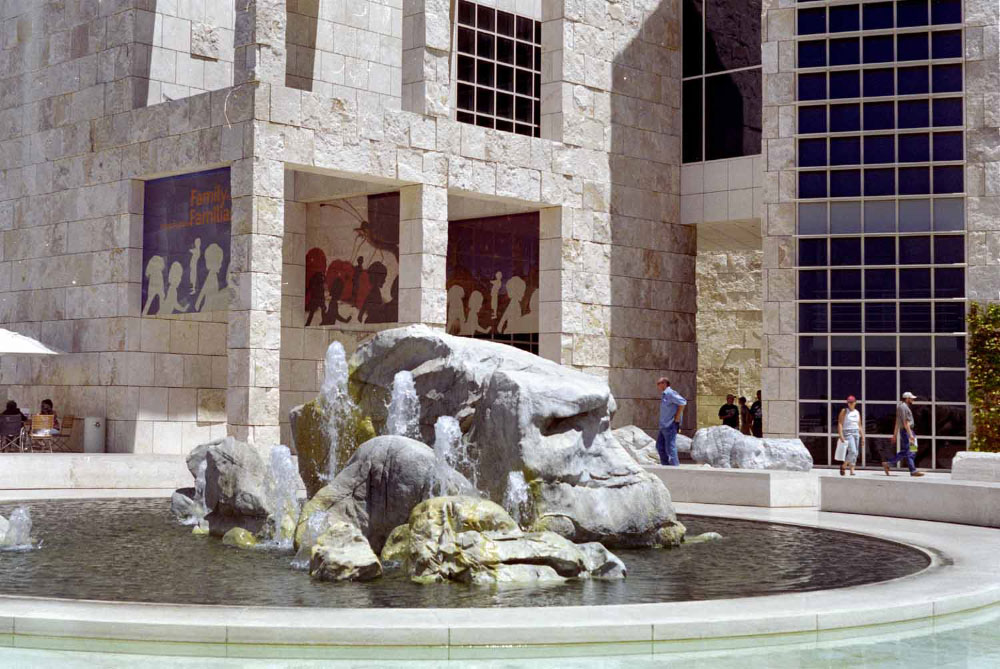
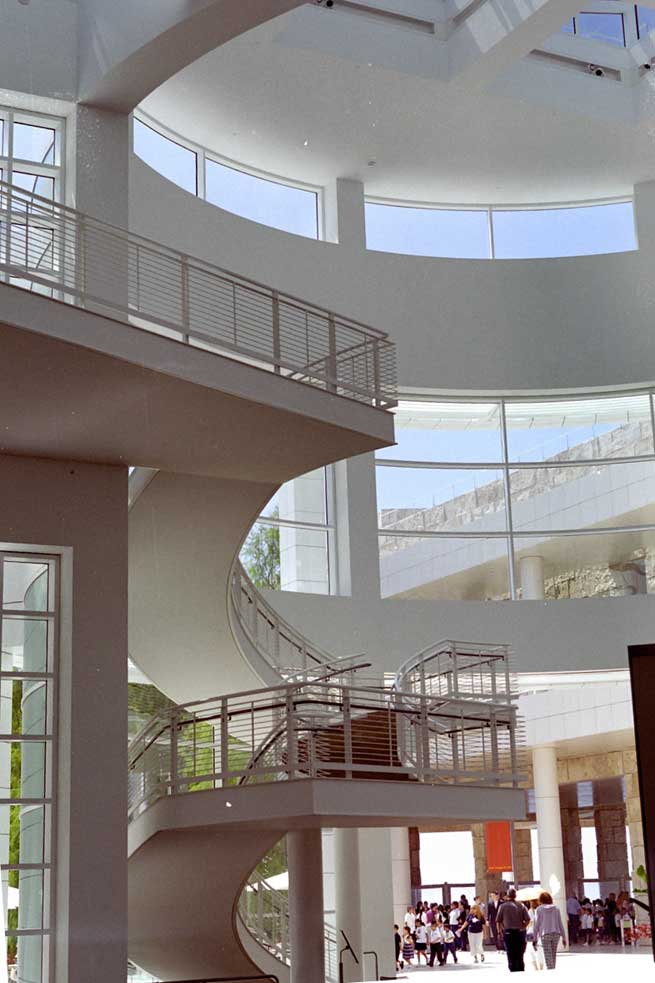
Below these photos are two photos in much higher resolution and far better jpeg taken with a vintage 1954 Contax on film by Allen Robert Gross© in August 2005.
Photos below by Allen Robert Gross ©2005 (taken with vintage 1954 Contax)
The Getty Museum in Malibu was a careful recreation of a Roman villa in Herculaneum that was buried in ash when Vesuvius erupted. The finest artisans worked with materials that included precious antique marble that had not been quarried for nearly 2000 years.
People who went to the Getty Malibu Museum could enjoy the building, the artworks, the gardens and fountains, with shaded colonnades and places to sit wherever they might want to go. I photographed the artworks for Mr. Getty as they were originally displayed in rooms especially designed for the various pieces and collections. (Not long after, a new director moved the displays to different rooms destroying the original concept.)
The new Getty Museum is a monumental complex of stone buildings on the leveled top of a mountain beside the 405 Freeway overlooking all of Los Angles. Everything is on a vast scale, yet for all those buildings, very little space is for exhibiting art, so that most of the Getty collection must be in storage.
The visitor gets off the tram the goes up to the museum from the parking garage to be confronted by a monumental flight of stone stairs. There is no indication of any alternative to climbing those stairs, and the infirm, the elderly, and people with small children make the ascent. Only if someone is actually in a wheelchair that cannot ascend the steps do the guards indicate that around a corner, unmarked and hidden from view is a white door in white wall and when one is near enough one sees that it has elevator buttons beside it. All the elevators in the new Getty Museum are equally hard to find.
Once the visitor has reached the vast main lobby that opens to the huge court, again there is little signage except to the store. The art is displayed in a random assemblage of buildings to which and in which there is totally inadequate signage. The visitor must go a significant distance outside with inadequate or no directions to get from building to building, which can mean a long walk in blazing hot sun, rain, or wind, and often in the wrong direction.
As an architectural monument and separately as a facility for scholarly research, the new Getty Museum is indeed impressive and certainly worth a visit for the experience and the view out across Los Angeles. But as a place for the public to easily and comfortably enjoy works of art, it leaves much to be desired.
When the Malibu Museum was temporarily closed at the time of the opening of the new Getty Museum, D'Lynn Waldron was an invited guest to be interviewed by the press. She was most concerned that everyone understand that the Malibu museum was constructed of the finest materials by the finest craftsmen and artists, a thing that can never be duplicated, and therefore the Malibu Museum Villa deserves to be maintained with the same care as the other artwork all over the world that the Getty Trust is preserving. To Author To article on the original Getty Malibu villa museum